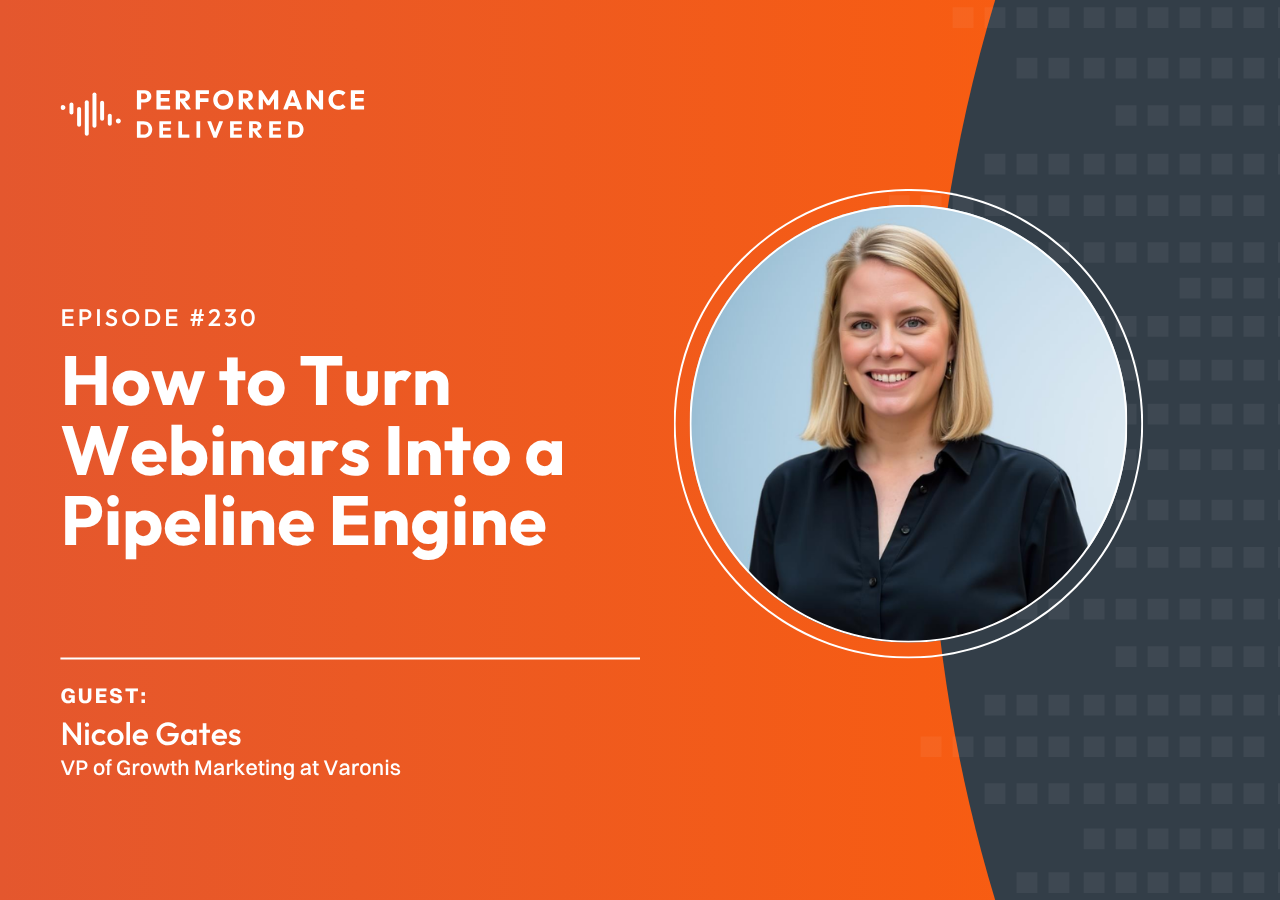
Say "webinar" in a marketing meeting and you'll usually get one of two reactions: a tired sigh, or someone declaring the format dead. Nicole Gates, VP of Global Growth Marketing at Varonis, has heard it all — and she's built a career proving the opposite.
"I always laugh when people say webinars are dead, no one attends webinars," she told Steffen Horst on a recent episode of Performance Delivered. "Across multiple companies, across multiple industries, I've always seen webinars be a very successful demand gen engine."
So why the disconnect? According to Nicole, it comes down to how most teams run them. When a webinar is really just a product demo in disguise — all about what your software can do — audiences check out. The teams that win treat webinars as a content channel first: a way to educate the market, share a point of view, and build trust.
Start with value, not the pitch
When Nicole builds a webinar strategy from scratch, thought leadership comes first. "I want people to come to our webinars because they feel like they're going to come away with something valuable that's going to help make their job better — versus just hearing a pitch about our product."
The proof is Varonis's monthly State of Cybercrime series. It covers trending hacks and issues in the cybersecurity world and never mentions the product at all. It's also grown into a brand of its own and become one of the company's top top-of-funnel lead drivers.
Match the webinar with the metrics to the funnel stage
The mistake many teams make is treating webinars as a single, bottom-funnel tactic. Nicole runs distinct series for different stages, each with its own definition of success.
At the top of the funnel, State of Cybercrime is measured on registrations, attendee rate, repeat attendees, and net-new leads — not demo requests. In the middle, thought-leadership sessions bring in influencers, analysts, or the company's own threat-labs team, layering in a soft pitch and a closing poll to surface hand-raisers. At the bottom, it's a straight product demo with no pretense. "We don't try to sugarcoat it," Nicole said. Because the brand has already earned trust higher in the funnel, people arrive knowing they'll see a pitch — and they're fine with it. One recent demo, featuring the founder of a newly acquired product, drew some of the best registration numbers the team had ever seen.
Let the data reshape your strategy
Because Nicole owns go-to-market across the board, she can use what webinars reveal to steer the wider strategy. Her favorite example: a push into the Salesforce security market. The standard "here are the breaches" approach fell flat with that audience. Through webinars, the team discovered the offering worked far better as an upsell to existing Varonis customers who also used Salesforce. That single insight redirected the entire demand-gen strategy for the product line toward target accounts and current customers.
Scaling globally: language vs. time zone
Expanding across regions is where webinar programs get expensive fast. Nicole's team experimented heavily with localized webinars — French, German, Spanish, Italian — and learned that a lot of that effort didn't pay off. Nordics, Benelux, and Germany converted just as well from a well-produced English webinar run in an EMEA-friendly time zone. France was the exception: "The French like to speak French, and regardless, we've got to go there" — and the attendance and conversion justified the investment.
The same nuance applies in APAC. Japan needs Japanese. India often speaks English comfortably, but a Sydney time zone simply doesn't work — so adding a second time slot became the fastest way to unlock a growing market. The lesson: don't over-engineer. Launch with what you have, read the data, and localize only where the numbers demand it.
Where AI comes in
AI is already changing how Nicole's team works. In the short term, it's about deeper analysis without the manual grind — breaking down webinar audiences by segment, seniority, and customer status. That kind of analysis on the recent demo surfaced a surprisingly high share of churned customers, opening the door to "wake up the dead" reactivation campaigns built around the new product.
Longer term, she's eyeing AI for dubbing content into other languages and running semi-live replays across time zones — so a small team isn't stuck hosting sessions at 2 a.m. to serve every region.
Advice for teams starting from scratch
Nicole's number-one piece of advice is consistency. "A lot of these initiatives — webinars, podcasts — people have a lot of ideas, then do one or two and run out of steam." Pick a cadence you can actually keep, even if that's just once a quarter. Start with thought leadership and the themes your product aligns to, not the product itself. Lean on your subject-matter experts and employee advocates. And give it time — at least a year to work its way out.
As for promotion, email works when you've built the database, but Nicole has seen the strongest net-new results from one-to-one SDR outreach and sales reps sharing on LinkedIn. Her pro tip: make it a competition. "That always motivates sales."
The throughline is simple. Stop thinking of webinars as events, and start thinking of them as a story you tell across the whole year — one that builds trust, generates pipeline, and compounds over time.
Episode Transcript
Steffen Horst (00:01.902)
Welcome back to Performance Delivered, Insider Secrets to Marketing Success, the podcast where we dive into what's driving results in today's ever-evolving marketing landscape. I'm your host, Stefan Horst, and today we're exploring how a smart, systematic approach to webinars can move beyond one-off events and become a true pipeline engine. In both where B2B buyers are more skeptical than ever, one marketing leader has cracked the code on turning webinars into a repeatable, scalable revenue driver.
across regions, the funnel, and now with the help of AI, even beyond that. Joining me today is Nicole Gates, Vice President of Global Growth Marketing at Bernice, where she leads global demand generation and go-to-market strategy. Nicole has built and skilled marketing teams that drive the majority of pipeline and revenue across multiple regions. Nicole is known for a straightforward experience-driven perspective on growth marketing, focusing less on individual tactics,
and more on building systems that actually scale. Chi shares her thinking on marketing leadership, pipeline strategy, and team building on her sub-stack, pipeline and perspective. Today we'll explore how Nicole thinks about webinars as a strategic channel from structuring programs across the funnel to scaling them globally and leveraging AI to do it more efficiently. Nicole, welcome to the show.
Nicole Gates (01:24.51)
Thank you. Thanks for having me. What an intro. I hope I can live up to that kind of intro. That was great. Thank you.
Steffen Horst (01:31.064)
But before we get into the mechanics of webinar strategy, I'd love to set the stage for marketers who might still think of webinars as a one and done content play. How do you think about their potential as a pipeline driven driving channel and what shifted your own perspective on that?
Nicole Gates (01:51.422)
Yeah, I mean, for me, webinars has always been a successful channel. And so I always laugh when people say, know, webinars are dead. No one attends webinars because like, I just, and the case for me, and this has been across multiple companies across multiple industries. Like I've always seen webinars be a very successful, command gen engine. And so I wonder if it is because, you know, a lot of people do kind of see it as, you know, a product demo. they're just kind of pushing out.
Steffen Horst (01:54.094)
you
Nicole Gates (02:20.424)
It's all about them. It's all about what the product can do. And it's less about content, educating the market, bringing value to your audience and building that trust, which is kind of how I view webinars where it's a part for me, like my content engine and ends up being a key piece into my overall demand gen strategy.
Steffen Horst (02:39.724)
Interesting. Now talk a little bit more about how your approach really is different to what you just described.
Nicole Gates (02:45.64)
Yeah, I think because we do have a few different types of webinars that we have. for me, each of those are treated a little bit differently. We have different success metrics around each of those. But truly, when I first building out a webinar strategy, I really focus more on driving value to the audience and focusing on that thought leadership aspect. I want people to come to our webinars because they feel like they're going to come away with something that's valuable and it's going to help make their job better versus just hearing a pitch about our product. I mean, obviously,
Once in a while I do have a pitch at the end, but I usually try to make it very small and make it relatable to what we're talking about. But usually if I'm starting from scratch, I really build off of that thought leadership first. And then I also make them super consistent. know, like we actually have a webinar series that we run currently at Verona is called State of Cybercrime. And we run it, you know, once a month, sometimes more. It kind of talks about trending topics, you know, hacks and things that are happening in the cybersecurity world. And it's
We don't even talk about a product whatsoever, but it's kind of grown into this brand of itself. And it's probably our one of our top, like top of funnel lead drivers. And then we'll use those audiences to kind of come into more products, specific ones or thought leadership, best practice stuff that will eventually tie back into Veronis.
Steffen Horst (04:04.91)
So one element I talked earlier about is using webinars across the funnel. Many people look at it more kind of in more funnel activity. Now, how do you think about the different types of webinars at different stages? So what is different there? What different webinars do you do from an awareness perspective, from consideration perspective, and then obviously from a kind of more action stage perspective?
Nicole Gates (04:34.814)
Yeah, so I do kind of have different webinars series based on the funnels. So that's State of Cybercrime. I considered my top of funnel the most top of funnel type of webinar. And so for me, I'm looking at metrics that are like new leads, audiences, attendee rate, like probably more fluffy quote unquote goals. I'm not really looking for demo requests and MQLs coming out of those. I just want to grow the registration list.
grow repeat attendees and have people coming multiple times. And it's our biggest driver of NetNew Leads. And then under that, we'll have more like thought leadership stuff, best practices. And that's when we usually start getting into the topics that our product can help with. So we'll talk about data security issues. We'll talk about things that happen within certain data security vendors or partners or sources. You know, now we talk about AI security a lot like everybody else does.
And so we'll still keep it pretty high level and it's very thought leader driven. We usually bring in, maybe we'll bring in an influencer, maybe we'll bring in an analyst. We'll bring in maybe people on our threat labs team who kind of talk about and deal with this with our customers every day and can kind of talk about the trends and what they're seeing and then have a soft pitch usually at the end. And then we have a more middle of bottom of funnel drive, which is more of a product demo once and it's straight up. We don't try to sugar coat it and pretend it's not a demo,
video or webinar, it's straight up just, hey, you want to come see this demo live, we're going to have our sales engineer on sometimes. We actually just ran one today, where we actually had the founder of the product that we just recently acquired come on and kind of talk about the bones and like, why our product is different. And it had some of the best registrations we've actually ever had, which was very rare for something that's straight up to saying a product demo. And I think it's because
We've grown that value-driven trust with our audience. So then by the time we come in and we're not trying to pretend that we're not gonna pitch you, people come in with that expectation and they're okay with it.
Steffen Horst (06:39.8)
They know exactly what to expect, basically. Now, you said for kind of the top of funnel webinars, obviously, you're looking more number of subscribers, are they appealing or are they showing up to us? When you go down the funnel, what are the success metrics there for you?
Nicole Gates (06:41.64)
Yeah, yeah, exactly.
Nicole Gates (06:58.24)
Yeah. So when we get into that thought leadership middle style webinar, I still look at attendee rate. I still look at registrations. But that's when I do kind of start looking at like, who are the hand raisers? We usually have a poll at the end that says like, Hey, do you want to hear more? We usually put a URL to one of our demo pages. And we do kind of see if we have those demo requests. My digital team who's in charge of our webinars, they're one of their KPIs is usually
demo requests from our webinars and that's their main KPI that they're going after. And then obviously with product demos, that's straight up demo requests from there is the KPI we look for.
Steffen Horst (07:35.65)
Yeah. Interesting. Now, what does it actually take to turn webinars from a one-off event into a repeatable pipeline engine?
Nicole Gates (07:45.342)
Yeah, I think it's putting it as a content strategy and not seeing it as like a just a solely a pipeline gen. I look at webinars is like, how can it help tell our company's point of view, help share our expertise, you know, help showcase why Veronis is different, help drive value. And I see it as like a story that we're telling throughout the year. And again, having that consistency, we usually have a pretty
set schedule. It's not like dates, but we're like, okay, we do this many webinars for North America, a quarter, this many for EMEA. We have this kind of topic, at least this many times a quarter or this type of topic once a quarter. And so we kind of have a cadence and then we make sure we stick to it and make sure that we kind of are thinking through, holistically from a whole marketing standpoint, you know, because I'm in charge of go to market across the board, not just webinars.
So I have the unique ability to be like, okay, what's our entire go-to market and how can webinars help support that strategy?
Steffen Horst (08:41.88)
So let's talk about that. how do you use the data information you collect from the webinar part of your activities for other marketing media activities to drive pipeline and grow business?
Nicole Gates (08:57.792)
Yeah, I have a really unique example that always kind of pops up. When I first started at Veronis, we were kind of entering into a slightly new market. And it was kind of a harder audience to kind of like figure out and we couldn't quite figure out the right positioning for it. So I was doing some webinars, I brought in some influencers from like that area. It was around Salesforce. We were trying to sell into about our Salesforce offering.
And we just realized the Salesforce audience was like slightly different than our typical audience. couldn't quite figure out how to kind of get their attention. And through webinars, it was kind of a bit of an experiment where at first, you know, we did our standard kind of like here's the breaches and the things that are happening, but that audience just didn't quite care. And so we found through webinars, not only the positioning, but also the audience. we realized it was much stronger as an upsell.
motion to current customers who already were getting value out of Veronis and then also had Salesforce. And so from that, it helped me shift my entire demand gen strategy for that product line to focus more on, you know, target accounts, current customers who had Salesforce versus trying to push this like new business angle for that product line specifically.
Steffen Horst (09:53.752)
Thanks.
Steffen Horst (10:10.137)
Yeah. Now, when you want to scale webinars across regions, I see this as probably a nice challenge because, you know, let's just say to you, I'm from Germany, there are multiple languages there, especially when talk about France and maybe even Germany, they don't respond so well to English, although, you you could go with that because a lot of users of the software probably are quite
Nicole Gates (10:21.655)
yes.
Nicole Gates (10:32.372)
Mm-hmm.
Steffen Horst (10:39.384)
familiar with the language, understand it. But when we go into other regions, into other markets to do the same thing there, how do you approach it? How do you go about local languages and getting the same output basically?
Nicole Gates (10:58.632)
Yeah, it's a little bit of an experiment and a test and try. Same thing, like it's balanced between, you know, catering to specific regions and languages, but also the resources on my team's ends are what our digital teams quite small. And so I have to kind of weigh like, okay, where's our biggest impact going to be to help drive growth. And so, you know, before, like, we've kind of changed and evolved and it keeps changing and evolving based on what we're seeing. So before we used to do
Steffen Horst (11:17.294)
Yeah.
Nicole Gates (11:28.448)
French, German, Spanish, Italian. We did it all. And I think we ran almost three French webinars. Like we did some in Quebec for Canadian area and then also for France. And we just found that some regions did really, really well, but others there was like, no one was showing up. It was really converting. It was just, just wasn't worth the effort at the moment. And we were finding that if we ran an English webinar, but just in a different time zone,
Steffen Horst (11:37.239)
Bye.
Nicole Gates (11:58.164)
That actually had a bigger impact across the region, even in like, you know, surprisingly like Germany, Benin Nord. So, you know, these regions still had people who showed up and converted just as much in the English, but EMEA time zone. And so we did make a shift last year where we were like, okay, let's focus more on just the English and really maximizing, making sure it's very good, well done webinar, maybe tailoring it to things that are happening in EMEA that aren't necessarily, you know, happening in North America.
that are relevant and then trying to experiment with segmentation and seeing how that works. I don't think we have like the perfect formula still, you know, I'm still, you know, now we're building up the French webinar specifically because we just found the French like to speak French and regardless, we got to go there and they do like have more people who show up, who convert and so that's worth the effort for me. But this is where AI kind of comes into it. I'm kind of curious how like
Steffen Horst (12:43.66)
Yeah
Nicole Gates (12:56.97)
I've been researching how to start using AI to help with some of this regionalization opportunities because since it is such a big growth driver, our sales teams all want webinars and they want more webinars. And so there's got to be a way that we can help replicate some of this without it having to be so manual.
Steffen Horst (13:07.298)
Yeah.
Steffen Horst (13:12.782)
Yeah, it sounds like sometimes over engineering things is not the best solution. know, it's probably better to try with what you have, see what the response is and then pick out the areas where you don't see the results, the response that you would want. Right. And I think it's a great example because if you go into Nordics, they don't have a problem with English. If you go to Benworks, they don't have a problem with English. know, Germans usually don't have a problem with English too. But in France and in
Nicole Gates (13:18.174)
Yeah.
Mm-hmm.
Steffen Horst (13:42.67)
We run a lot of campaigns in Europe for other clients. You've got to be in French there. They just don't respond to English. That's just something that you need to know. And it might be the market where that's the only one when you have to adjust something. when you go out of that region, you go to other regions, you might be well off with English alone and you don't have to, except for Latin America potentially.
Nicole Gates (14:06.334)
Yeah, exactly. We're running into that now because we're also like growing out our APAC region even more. And we were just running English, Sydney, Australia time. Japan is a similar one where you definitely need to be Japanese and speaking Japanese. And so now we're building out more regional webinars there, but also India, you know, even though they'll speak, if they're okay with English, the time zone, Sydney time zone just doesn't work for them. And so like adding in another time zone is a quick way to kind of
Steffen Horst (14:18.126)
All right. Enjoy the job. Yeah.
Nicole Gates (14:35.562)
capitalize on a growing market that we're seeing and seeing if we can, you know, maximize a pipeline in those areas.
Steffen Horst (14:41.486)
Yeah, and I think you just mentioned a really important thing. It's not just about language, right? It's that you have to take in consideration. Are you aligning your webinars with the respective time zone of bigger markets? For example, it's like China, India, you know, just as you said, keeping them in Sydney time zone for them means several hours time difference, right? And that might be an inconvenience, basically. But you want to be able to figure it out until you start launching things, that you start collecting data and analyze the data, basically.
Nicole Gates (14:46.611)
Mm-hmm.
Nicole Gates (15:11.303)
Exactly. Yep.
Steffen Horst (15:13.026)
So you already talked about AI. I want to dive in little bit more on that side. When do start to use AI to scale or improve your webinar program?
Nicole Gates (15:25.396)
Yeah, I think the short term one right now is we're using AI a lot to analyze our webinars at a deeper level than we were able to. So for example, the product demo that we did today, we used AI to kind of analyze the audiences that went there so we could understand what percentage is small media business, what percentage enterprise from the audiences, what percentage is CISOs versus practitioners, what percentage is customers versus new prospects versus...
we actually found out there was a high percentage or higher than we thought of churned customers. And so that kind of opened up discussion where we're like, Hey, you know, now we have this kind of opportunity. seeing this need. We'll probably put together like wake up the dead type campaigns, kind of see if we can convert some of these churned customers with this new product that we're, we're releasing. so short term, that's like the easiest way is just kind of getting better at analysis and research into the webinars that you're doing without having to do all that manual work.
but long-term kind of what I said, I'm looking for solutions that can maybe dub, you know, different languages or repurpose things a lot faster. maybe do, you know, those semilive replays in different regions and time zones so that it doesn't have to be one of my team, you know, being up at 2 a.m. kind of running these things. We could have things running and have like a styles rep kind of helping in the background versus us being up. And then that's going to help our regional.
know, regionalization much more, keep our sales team happier, but also allow us to just kind of hit these kind of opportunities that we just don't have the resources to accommodate for right now.
Steffen Horst (17:04.12)
Yeah, that makes sense. Now, from a... No, I lost my train of thought to I actually wanted to say. Give me one second. I just need to find a back. Biggest opportunities. We talked about that. I got it. Okay.
Nicole Gates (17:13.728)
No, that's okay.
Steffen Horst (17:26.254)
Are you predominantly producing live webinars or do you also have kind of an on-demand webinar for people? And then the second question to that is, do you see much of a difference when it comes to performance between the two live versus on-demand?
Nicole Gates (17:44.67)
Yes and yes. So most of our webinars is completely live and then we do run them on demand on our website just as a recording. And we also do run them through contents indication. So we'll usually take our webinars and we'll run them through, know, Bright Talk, other contents indication, you know, partners that we have access to. The contents indication piece works really well. I would say that helps us get new.
customers in or new leads, it exposes it more. So we do see that as like a pretty fruitful channel as well. But I'd say the on demand how we have it set up now, which I just think probably isn't the perfect way, I'll be honest. It's like a few trickles, not a lot of leads are coming through, not a lot of MQLs, like the bread and butter is definitely in the live, which is why, you know, looking at AI solutions or other webinars, software solutions like
I feel like semi-live is probably that answer because like, I think people probably convert higher when they're actively engaged versus watching a recording. And there's gotta be probably a middle ground with that. But it's an avenue, like an area where I think there's a lot of opportunity that we could get into that I just, we haven't put a focus on at the moment.
Steffen Horst (18:59.586)
So what I'm hearing is like, although the content probably is relevant because there's not that life engagement between the people viewing the webinar and someone being available, that's the predominant difference between life and on demand. Is that correct? Okay, makes sense. What would you tell companies that, was like, this is interesting.
Nicole Gates (19:12.595)
Mm-hmm.
Nicole Gates (19:17.63)
Yeah, yeah, exactly.
Steffen Horst (19:28.942)
We really just thought about it as a lower funnel activity. We really want to explore trying to use webinars across the funnel. What would you push them to start off?
Nicole Gates (19:43.368)
Yeah, I push them first to just think of a schedule that they can keep to. really do think consistency is the key. think a lot of some of these initiatives with webinars, things like podcasts, people have a lot of ideas and then you do like one or two episodes and you kind of run out of steam. And it really is a long game to kind of turn it into a full funnel engine. So kind of be like, okay, maybe once a quarter, just start once a quarter if you haven't done anything and be like, we're thinking thought leadership.
don't even think about your product at first, but just more of like the topics and themes that your product aligns to. And who in your team maybe can speak to that. Everybody's got subject matter experts. I'm a big believer in employee advocacy and kind of bringing the voice of the people on your team out. so like identify those people who one can speak well on a webinar, because I found some people just not the best and can speak to that topic and be okay that they don't, you're not going to have.
a huge attendee rate or a huge demo request right out of the gate, give it at least a year to kind of like factor, like work its way out.
Steffen Horst (20:51.458)
Yeah, so it's a commitment in the end, right? Of anything you're doing. Now, any thoughts on how to get the word out about the webinar or the webinar series that you see really well?
Nicole Gates (20:53.909)
Yes.
Nicole Gates (21:03.124)
Yeah. Yeah, I think, you know, for us emails work really well. But I think it's because we've built a pretty good database that's obviously the top of funnel is that webinar. But what we've seen other success with is actually our sales reps using it, you know, reaching out to their prospects or onto their own LinkedIn. We do social promo and some paid ads behind that as well. But it's actually that kind of like one on one SDR, you know, outbound reach that
is bringing in more new stuff. So if you're kind of building stuff from scratch, maybe you don't have that database necessarily. Hopefully you have something like Sales Navigator or somewhere where you're kind of pulling in some target accounts and kind of put your sales team to work and be like, hey, like this is something that could help drive pipeline. It could help make you look like, you know, an expert in your field. Like here, it's here's a tracking link, maybe make it a competition. That always motivates sales is what I've discovered.
So make it a competition and see how many new registrants each salesperson can get.
Steffen Horst (22:03.736)
Yeah, interesting. Nicole, thank you so much for joining me the performance of our podcast and sharing your thoughts on how to build webinars into a genuine pipeline engine. The way you think about resistance, scale, and relevance is really interesting because, as I had mentioned,
I always thought about it more from a lower funnel activity. but it makes sense. It's like this podcast, right? Having a conversation about topics and hoping someone listens to it. was like, this is interesting. Maybe I give this company some point, digital call and find out what they are doing or gives your company a call and don't see up what they're doing. What are the listeners who want to follow you and you know, what do you think about growth marketing, pattern surgery, team building?
Where can they find out more about you? And where's the best place to read pipeline and perspective?
Nicole Gates (22:57.524)
Yes, that's on my sub stack. So just come find me on sub stack. You can either search pipeline and perspective, or you can search my name and find me. I'm usually sharing some random thoughts about marketing and everything on notes there, or feel free to connect with me on LinkedIn. I also share on LinkedIn quite frequently. I share some memes. I try to be funny. You guys can be the determining factor if that's funny or not, but those are the two best places to find me.
Steffen Horst (23:24.27)
Perfect. As always, we leave that information in the show notes. Thank you everyone for tuning in. If you enjoyed this episode of Performance Delivered, please subscribe and leave us a review on iTunes or your favorite podcast application. To find out more about Symphonic Digital, visit us at symphonicdigital.com or for us on X at Symphonic HQ. Thanks again and talk to you soon.