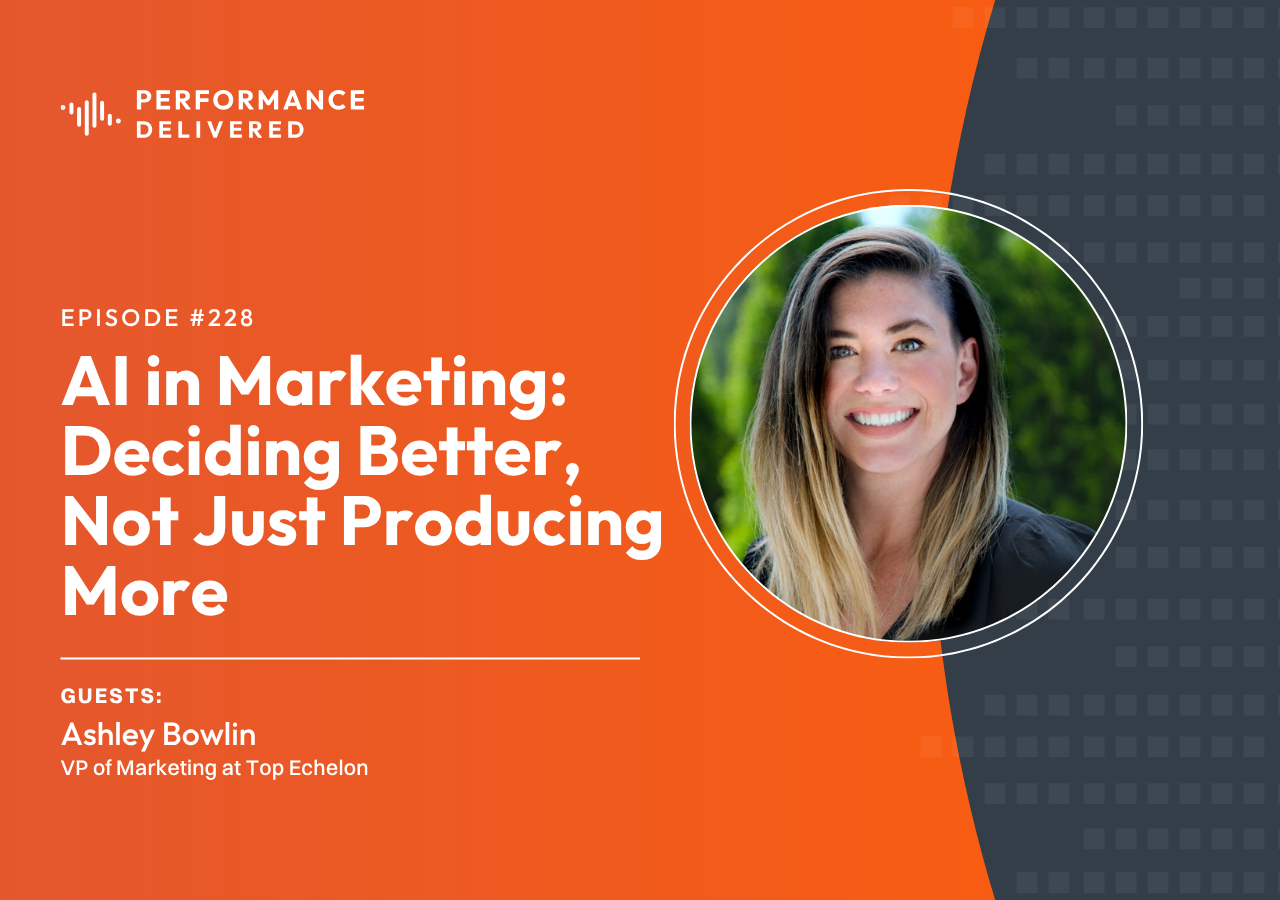
Most marketing teams reach for AI to produce more: more content, more campaigns, more output. Fewer teams are using it to make better decisions.
That distinction is the difference between AI adding noise and AI adding value, and it's the focus of a recent conversation between Steffen Horst and Ashley Bowlin, a marketing and growth executive with nearly 20 years of experience across SaaS and professional services.
Why Teams Default to Output Over Decisions
Writing and content production are time-consuming, so AI looks like an easy lever to pull. But taking AI output at face value, without iteration, strong prompting, or clear positioning behind it, produces content that is generic and misses the mark.
A brand's ecosystem now extends across the entire internet: every place it's discussed, reviewed, or mentioned. Getting that right takes research and a clear point of view, not just more words published faster.
Where AI Adds the Most Value in a Marketing Strategy
Pressure-Testing Positioning
Instead of using AI just to write about positioning, feed it internal reports, customer quotes, and team insights, and have it distill that into a clear read on how your ICP actually perceives your brand today. Layer in research on the competitive landscape, and the output can inform not just marketing, but product and sales as well.
Researching Buyers Where They Actually Start
Depending on the source, a B2B software buying journey can involve 20 to 70 touchpoints, including G2, TrustPilot, LinkedIn, and increasingly direct conversations with ChatGPT or Gemini, often before a prospect ever visits a company's website. Discoverability now has to be engineered for LLMs and review aggregators, not just search engines. A practical starting point: ask your LLM directly how to improve your discoverability within LLMs, then verify the answer rather than treating it as a finished plan.
Closing the Gap Between Insight and Action
AI is often used purely for analysis. It's more useful applied to your own workflows, surfacing where data isn't being captured or where a process needs a missing connection, such as a CRM field or a reporting step. This isn't about generating new strategy from scratch. It's about improving what already exists.
Supporting GTM Alignment Across Teams
For the cross-functional work that connects brand, product, sales, and partnerships, a closed, company-specific LLM that already knows your ICP and annual goals can help position a new product launch and even role-play likely customer questions before it goes out the door, instead of everyone wading through pages of release documentation separately.
How to Get Better Recommendations Out of Your AI Tools
- Train the model not to just agree with you. LLMs default to being agreeable. Explicitly instruct the model to challenge your thinking rather than validate it.
- Read output critically instead of accepting it at face value. Treat every AI recommendation as a draft, not a final answer.
- Ask for options, not one answer. Request an A version and a B version, then tell the model what worked and what didn't so it improves over time.
- Run a "post-mortem" on the recommendation. Ask the model to project forward and critique its own suggestion, surfacing where it could go wrong, as a second layer of scrutiny before you act on it.
Common Mistakes to Avoid
Producing Content for Content's Sake
Organizational pressure often pushes teams to make AI multiply output. The better fix is well-defined goals that go beyond raw content volume or lead counts. A blog post that's still accurate and well-written doesn't need five new versions saying the same thing five different ways.
Treating AI as the Final Decision-Maker
At the strategic level, human judgment still has to lead. AI is valuable for research and staying current, but leadership still has to synthesize that information, weigh competing priorities, and make the call. AI shortens the distance to a well-informed decision. It doesn't make the decision.
Repurpose Content Instead of Multiplying It
Rather than manufacturing more content from scratch, take strong existing material, a conversation, podcast, or interview, and give it more formats: a transcript, an infographic, a short video. That reaches people who prefer to read, watch, or listen without adding volume for its own sake.
Where This Leaves Marketing Teams
AI should free up time for the parts of the job that still need a human: conversations, events, relationship-building, and the judgment calls that come from experience. Used well, it takes the deep-research burden off a team's plate so there's more time for the work AI can't replace.
If your team is trying to use AI to sharpen strategy and positioning rather than just produce more content, Symphonic Digital's analytics and SEO services can help you build the research, measurement, and discoverability foundation that makes AI outputs worth acting on.
Episode Transcript
Steffen (00:00.716)
Welcome back to Performance Delivered, insider secrets to marketing success. podcast, we explore what's actually driving growth and performance in today's complex marketing landscape. I'm your host, Stefan Horst, and today we're diving into a topic that's on every marketing leader's mind. How AI is reshaping the way we think about strategy, not just speed. Most teams are using AI to produce more, more content, more campaigns, more output.
But the marketers pulling ahead aren't using AI to move faster. They're using it to decide better. So what does that actually look like in practice? And how do you make that shift? Joining me today is Ashley Bolin. Ashley is a marketing and growth executive with nearly 20 years of experience helping SaaS and professional services companies grow through smarter go-to-market strategy, connected teams, and impact-oriented action.
She specializes in building the glue functions that sit between brand, product, sales, and partnership, holding GTM together and tuning complexity into clarity. Over the course of her career, Ashley has led marketing, product marketing, partner development, content, customer engagement, and executive level GTM for both high growth and high change environments. She is at her best when she's building something, a brand.
an integration ecosystem, a partner program, or a new revenue motion. Today, she's here to talk about how she's actually using AI, not to generate more noise, but to think more clearly and make better decisions. Ashley, welcome to Performance Delivered. It's great to have you.
Ashley Bowlin @ Top Echelon (01:44.377)
Hey, Stefan, thank you so much for having me. I'm excited to be here. This is such a timely topic, so I'm excited to dig in with you and cover some things that I'm seeing working and also just help people get thinking in the right direction on where this whole channel is evolving and where we're going as marketers.
Steffen (02:05.462)
Wonderful. Now, Ashley, let's set the stage before we get into the details. There is a lot of noise right now around AI and marketing. Everyone thinks all they need is AI, and then they will stand up the best campaigns, get the best results. No one needs experts anymore because AI is the expert. But you've drawn a clear line between teams using AI to produce more and teams using it to
decide better. In your view, why is that distinction so important? Why do so many teams default to output rather than looking at the decision-making side?
Ashley Bowlin @ Top Echelon (02:47.231)
I think it starts with communications, writing. It can be time consuming. I think.
You know, it just seems like an easy button lever. But what you're missing when you just rely on, you know, LLMs and generative AI is if you're just using it to write content and you're not iterative and you're not giving really strong prompts and helping it learn and work through positioning. If you're just taking it at face value, you're doing yourself a disservice because you're not going to really hit the mark. It's going to be too generic.
lot of things that could go wrong and plus, if you're just using it to turn out more content, that's not what we need, that's not what anyone needs. We want to hone our story. We want to understand what our customers are interested in first and foremost, not just push, push, push. And I think that's where...
It becomes really interesting is just how we're approaching marketing as a whole, how we're using AI, what intent signals we're looking at, how we're measuring success. You know, it's not just about.
clicks and impressions and website traffic anymore. Your ecosystem for your brand is the entire internet. Who's talking about you? What your third party properties look like? And all the strategy that goes behind that. it takes the research, the deep research. takes working with your sales and customer teams to understand what they're hearing and then making sure that you're putting out
Steffen (04:02.51)
Mm-hmm.
Steffen (04:11.522)
Mm-hmm.
Ashley Bowlin @ Top Echelon (04:28.368)
content, but also just positioning and communications and information that are going to help your customer make the decision that they're.
Steffen (04:38.838)
Yeah. So one of the first places you apply AI is around market awareness and positioning clarity.
Ashley Bowlin @ Top Echelon (04:47.288)
positioning sure
Steffen (04:50.074)
You've said you use it to pressure test how your brand shows up in markets, right? That's a pretty different use case than most people think about it, right? So what does that process actually look like? And what kinds of insights tend to surface when you run your positioning through that kind of scrutiny?
Ashley Bowlin @ Top Echelon (05:08.448)
Absolutely it so I started working with the company I'm at now about four months ago, and it's an incredible You know it's software sass I think a lot of marketers that work in this space can can relate you know it can become a Pretty overcrowded space doesn't matter what software you're selling. There's always going to be others And so how do you?
Find out differentiation, right, is the core. But what does that really mean? It's not just, we want to be this. It's, what do our customers see us as? How do we present that in the market? And how do we get more of those? And then by the way, what is the next relevant space to get into? How do we expand our TAM? How do we grow in a way that's meaningful, in a way that has product market fit? you're using, I'm using on a daily basis,
as much insights as can get from our team members, data, and then you can use AI to just distill it into something that makes sense. Hey, know, review these reports, review, you know, this is our customer insight, here's some quotes, and also do some deep research on the website, or on the internet, and let me know what our, you know, this is our ICP, what are they interested in right now? What are their pain points?
And then you can use that information not only to inform marketing, but also to inform your sales cycle, product, you know, all of those things that really need to be working in tandem to deliver the best results.
Steffen (06:41.602)
Yeah. So it sounds like you let AI do the hard work, basically surfacing information, and then you take that output and that's when the thinking comes into the picture. Right. So I always say, when I talk to clients, come, well, you're using AI and usually that spins into, want to pay you less. Right. It's like, well, you get 70 to 80 % of AI. know, that's if you're happy with that, fine. But where the value comes and it's your value, what you just explained or
as an agency value comes as like taking that 70 % and bring it to 100 % by asking the right question, by taking the right or taking the information and making advanced decisions basically.
Ashley Bowlin @ Top Echelon (07:23.534)
Absolutely, think it's especially at first when we first got our hands on, know, chat GPT and Gemini and cloud, you know, it was easy to kind of take what it gave you at face value, but there's so much more value and there's lots of people that talk about this, but having an iterative process and asking it questions and say, well, you know, why do you really think that?
Mr. Chachi BT or you know kind of questioning it and making it go through a deeper dive and then imparting your human knowledge back to it. there's a lot of deep research that can be done that's helpful.
Steffen (08:07.916)
Yeah, yeah, makes sense. So you've also talked about a major shift in how people find and evaluate solutions today and how that changes what marketing needs to do. So with AI search changing buyer behavior, the old playbook for capturing and nurturing demand is getting disrupted fast. How are you thinking about aligning marketing strategy to the way buyers actually research and make decisions now versus how they did even to
three years ago.
Ashley Bowlin @ Top Echelon (08:39.726)
When I hold roundtables or speak on this topic, I always start by saying, if you're looking to buy something, where do you start? What do you do?
And think about that, your customers are doing the same thing and it's not just one thing. think, depending on who you ask, there's 20 to 70 touch points in a customer journey when they're looking for software. That's where I sit for SaaS. And so that's not just your sales team making 20 calls. That's not you sending 20 emails. That's not having 20 landing pages, right? That could be them finding you on G2 or TrustPilot. That could be them looking at your
Steffen (09:03.682)
Yeah. Yeah.
Ashley Bowlin @ Top Echelon (09:20.592)
LinkedIn, that's them doing deep research on Gemini or Chad GPT, there's all these places that you as a business and as a marketer want to make sure that you are discoverable and not only discoverable but that you're selling and telling the right message and that kind of goes back to that positioning. It starts with that foundational level because it's all going to of spider web out from there.
Steffen (09:45.997)
Yeah, yeah. mean, what we, for example, have seen is that more and more people, especially on the B2B SaaS side, they actually go into LLMs and start their journey there. Because it's so much easier to collect a lot of information about who the competitor is, what product is out there to solve my problem. And they do a lot of research there before they even hit the client's website. You're absolutely right. There's G2 and then all these other aggregator sites that has information.
The AI goes into those pages to and pulls the information. So people get much more used to starting there in finding a whole overview instead of going to Google. And then Google gives you lots of links. It might give you an AI overview, but that might also be not as complex as you will get from a, I don't know, Cloud, Chat, GPT, whatever LLM you're using. And with that in mind, you obviously have to change how
how you present yourself. You have to think about what are people asking in LLMs when they are looking for a software like Agos, for example,
Ashley Bowlin @ Top Echelon (10:55.584)
Exactly. And the other thing I recommend is, you know, if you feel like you don't know where to start, or you're overwhelmed, ask, ask your favorite LLM, you know, hey, this is what I'm trying to accomplish. Based on, you know, your expertise and discoverability and LLMs, how would you approach this and go back and forth with it? And then you're not just taking
something and copy and pasting it, you're learning as well. And if you cite sources and you can do your own research and make sure, mean, you gotta take everything that's generated on the internet, regardless of if it's AI or written by a human or whatever, with a grain of salt. So make sure that you're double checking that. But that's also a great place to start. Because it's changing constantly too.
Steffen (11:33.666)
Yeah. Yeah.
Steffen (11:40.055)
Yeah. Yeah. Yeah, I totally agree. Now, a lot of marketing leaders talk about wanting to be data-driven, but there's often a gap between having insights and actually acting on them quickly. How are you using AI to close that gap, to turn an insight into a test and a test into a decision faster than you could before?
Ashley Bowlin @ Top Echelon (12:06.156)
A lot of times it just helps me uncover where we're missing data or where we're missing an opportunity to capture data in our marketing or sales cycle. So if I'm brainstorming or working on strategy, I'm like, okay, I need to connect this, this, and this, or I wanna make this workflow. And then I can highlight, I need.
Salesforce or any you know whatever to have this so it helps inform and it helps you kind of workshop your workflows So that you can then fix those those issues that's how I've been using it and it's been pretty effective because you're able to To put it into action with your existing workflow. It's not like you're creating a whole new thing, but it's just like how can we make this better?
Steffen (12:48.834)
Yeah. Now, you spend a lot of your career building the connective tissue between brand, product, sales, and partnerships. Those GTM glue functions, basically. How do you see I helping or potentially hindering alignment across those functions? And what does it take to make it a connective force rather than a source of more fragmentation?
Ashley Bowlin @ Top Echelon (13:16.014)
Well, I'll give you one easy win is when, in SaaS, I think every marketer's probably experienced this, and there's a new feature, a new product release, and it's super exciting. then it's like, you're going through pages and pages of release documentation and more complicated stuff. And it's like, OK, I mostly know what this means. But having the ability to have AI, and especially if you have an LLM that's closed off, right?
It's within your company's ecosystem, so it knows exactly who you are. And you're like, OK, we've defined our ICP. We know what our goals are for this year. This is a new product, a feature that's coming. Help me figure out how best to position it to our existing customers, to new prospects, what questions might come up, and kind of almost role play with it in that way, too.
Steffen (14:14.382)
Now, LLMs are notorious for pleasing all of the people that using it. How do you question what LLMs give you as an answer to make sure that the recommendations that you get actually are sound and not just a statement to make you feel good?
Ashley Bowlin @ Top Echelon (14:40.454)
it's a great question because and I don't say that to be chat GPT but but but you're absolutely right. And I think that you can train them. You need to go in and say remember not to just agree with me, you know, inform it what you're looking for.
And then, mean, read what it says, right? If it seems wrong, you know, don't, like I said, don't just take it at face value, but iterate and then it will continue to learn and give better insights going forward. You're not starting from scratch, you know, as a marketer, you know, you know what you're talking about, you know, you know, for the most part what you're doing, but you're iterating, you're trying to like be broader and think outside the box, I suppose.
Steffen (15:23.502)
Yeah, I think that highlights just again, the point that don't just copy what it gives you, right? mean, read it, think through what it gets and, and make sure it is all something. One thing I've started over last month, I think to do is this is kind of this is a phrase called post-mortem, basically, to just say post-mortem what you gave me and it kind of goes
Ashley Bowlin @ Top Echelon (15:30.69)
Yes.
Steffen (15:50.999)
ahead in time and then looks at his recommendation and then critically basically reviews it and said, I might have gone wrong here or this could be this problem, which I find really interesting because that kind of gives you another layer of another layer of, I don't want to call it security, but it gives you another point of view of what it just gave you information wise.
Ashley Bowlin @ Top Echelon (16:14.352)
Absolutely and it helps it learn too so that going forward
Steffen (16:16.974)
Exactly.
Ashley Bowlin @ Top Echelon (16:19.394)
it hopefully won't make that same mistake or it'll have that background. But also just requesting like, you know, A B's, you know, give me an A version and a B version, or A option, B option. And then telling, know, giving it feedback and saying, I like this one because it fits better with blah, blah, blah. Or I liked what you suggested here, but I didn't quite agree with it because of XYZ and give it the data so that it, again, it's continuing to learn and be better.
Steffen (16:49.41)
Yeah, so you've been direct about what you are not doing using AI to just generate more content or noise. That's an important boundary to draw, especially when the pressure to produce more constantly is kind of increasing. I think within organizations, like, now they have this tool, this solution. Our output must multiply, whatever it is they give you. But how do you hold that line in practice? How do you say, stop?
Yes, that might appear like that, but here's the reason why we shouldn't go there. So how do you help teams resist a pull towards output for output sake when stakeholders are asking?
Ashley Bowlin @ Top Echelon (17:34.191)
Yeah, I think that it comes down to having well-defined...
goals as a marketer and I don't just mean like X number of leads per month, right? We're better than that. There's more to offer. Yes, if we're not impacting revenue, then we're not making an impact. However, there's a lot of ways and a lot of measurements that matter before you get down to that bottom of the funnel. So.
to creating content, think, I hope we've kind of moved past that, you know, a year two, three years ago where it was like, let's just turn out as many blogs as possible and talk about, you know, these five things in 35 different ways. I think now, and I think a lot of it has to do with LLMs because it doesn't necessarily matter if your blog article or your
you know, long form content page was published in 2025, if you've updated it and if it's still relevant and it's written well enough that it's, you know, surfacing information that people are looking for. So I think honing in on your existing, yes, consistent content and drum beats are important, right? To an extent that it makes sense and that you're...
Steffen (19:00.268)
Yeah.
Ashley Bowlin @ Top Echelon (19:03.178)
offering value. So I, know, if there's more iterations that need to happen, you know, what's actually performing well, what do we think would be performing well and is not, and how can we iterate on that? And it all kind of comes back to like, what is the what is goal? Are we trying to get more visibility for these search terms? Are we trying to get more?
Steffen (19:16.44)
Mm-hmm.
Ashley Bowlin @ Top Echelon (19:27.434)
awareness. So we want more stuff to put on LinkedIn, so that we have more to talk about. And people see us. That's a great, you know, that's a common and great goal. It's about how you approach it. And people don't want to read a lot, you know, there are some people I actually like to read. I prefer reading over over like audio, but I that's just, that's the other point of it, right? If you're going to the trouble to create content, how can you give it more
our legs and put it into formats that are going to appeal to a broader audience of people because people like to learn and consume information in all kinds of ways. So that's a little bit of a tangent, but also I think an important thing to recognize is not just about, you know, putting out words left and right.
Steffen (20:08.866)
Yeah.
Steffen (20:17.826)
Yeah, it's this linear thinking. like, well, there's a blog post with the information, just read it. While at the same time, like what we do here at the moment, we're recording this podcast. Now, if you like to watch a video, can go to YouTube and see us talking. If you just want to be on Spotify, for example, you can listen to us. Or if you want to read it, you can go to the page and read it. So there's three different formats for you to consume the content. The same applies for blog posts in general, right? There's so much.
Ashley Bowlin @ Top Echelon (20:25.294)
Peace out.
Steffen (20:47.246)
system available these days to turn your blog post into a sound file, for example. And therefore, you know, people, when they drive to work, they can just listen to it instead of having to sit in front of a screen wherever they are in order to consume it.
Ashley Bowlin @ Top Echelon (21:02.422)
Exactly. And I actually love starting, you know, for for juicier bits of content starting with
a conversation, a podcast, a video, an interview, a meeting, because it's so much more natural, you're getting you know, that back and forth human language and interaction. And then you can use AI, you know, turn this into a transcript, turn this into an infographic, turn this into, know, whatever and boom, it's got, you know,
way more legs. And it's not about just creating more content for the sake of content, but it's how do we make this more easy to consume for our audience in the different formats that they may like.
Steffen (21:45.967)
I agree. Now, you work across some of the most complex GTM environments, vertical SaaS, partner ecosystems, revenue acceleration programs. In those contexts, the stakes for wrong strategic decision are high. Where do you see AI having the most meaningful impact on executive level decision making? And where do you think human judgment still has to lead?
Ashley Bowlin @ Top Echelon (22:12.984)
That's a great question. At the strategic level, think human judgment is everything. I think in practice, there's a lot, as I've mentioned, that you can do to get insights with AI and help inform those decisions. But at the end of the day,
It really needs to, you're expecting your leadership team to be able to make an executive decision and be able to think it through and know what they're talking about. And again, is why I really like using it for research and learning because you gotta keep up as a leader, as a marketing person. But you're right, is SaaS and.
you know, this space and I think for a lot of companies in general right now, it's super competitive and it's very, you know, if anyone's ever, there's always someone to answer to and someone who has big ideas and so making sure that you're,
working towards those goals and also accomplishing what you and your division know to be effective, whether it's marketing or product or sales or customer. But ultimately you wanna make sure that your board or your PE group or your investors are feeling like they're getting heard and that you're also working towards the bigger company goals.
Steffen (23:40.771)
Yeah. Yeah. So it sounds like it's kind of what we talked about earlier, right? It's identifying where LLMs can add the greatest value for you in this specific situation, right? It's about gathering information that you then use to make senior level decisions, basically, because of the experience that you have, you can take that information, can dissect it, can pull the right information out of it to guide your decision.
basically. Is that about right?
Ashley Bowlin @ Top Echelon (24:15.052)
Yeah, absolutely. And I also like, you know.
Sometimes it's easier just to dictate into the LLM and say, yeah, this is what I'm working on. You know, just really let it have it with your brainstorming and where you're at in your head and just download and then say, okay, can you help me distill this into, you know, a plan of action or a strategic pitch for our, you know, whatever it is, whatever you're working on, you already have the idea, you've got the insight. But sometimes it could be more important
Steffen (24:37.806)
Yeah.
Ashley Bowlin @ Top Echelon (24:48.388)
to just make sure that it's clearly written, right? That you're presenting it to your audience in a way, know, TLDR, what they want to know.
Steffen (24:58.572)
Yeah. Now, in a previous conversation, you mentioned that building human-centered experiences, especially in an AI-driven world, is kind of important. That tension between efficiency and humanity comes up a lot right now. How do you think about preserving the human element, and what does that look like concretely in the work you're doing?
Ashley Bowlin @ Top Echelon (25:24.844)
I love this question because this came up 10 years ago for me when automation started becoming bigger, right? And so working with my team at the time and it's like, okay, we're gonna use the...
Steffen (25:32.802)
Thank
Ashley Bowlin @ Top Echelon (25:40.591)
We're gonna automate some of these email things that we're doing essentially. Long story short. And at time I was like, if we do that, then what are we gonna do? And I was like, so much. There's so much we can do, right? And so my hope for marketers and humans in general is use AI to help you go faster or get to decisions faster. Do that deep research, make better informed decisions.
decisions and then you have more time for the human element which is still very very important, know, record something like this, you know, talk to people, have conversations, go to conferences and events. I think it helps, it should help us have more time for that, those human elements.
Steffen (26:32.332)
Yeah, I mean, in the end, it helps us to unsurface an amount of information that we probably individually, even as a team, wouldn't be able to unsurface, right? I mean, if you do a deep research, as you said earlier, you get a whole lot of information on the topic that you're looking at, probably to an extent that a human wouldn't be able to do that. That's great. So you take a lot of time off the table there. But then it's really taking that information and making something of it.
That's kind of where I think there's a human element between AI and human. It's going to be important now, but it's also going to be important moving forward, at least for the foreseeable future, I believe.
Ashley Bowlin @ Top Echelon (27:16.152)
Totally agree.
Steffen (27:17.696)
Now, Ashley, thank you so much for joining me on the Performance Dilbert podcast. What I'm taking away from this conversation is that the real competitive advantage isn't just having access to AI, it's having the clarity and discipline to use it where it actually matters. Sharpening your thinking, as I just said. Aligning your teams and making better decisions. In those case, faster, better, faster decisions. That's a much harder thing to copy.
than a content workflow that you set up or an automation that you set up a while ago. For listeners who want to learn more about you at work and want to connect with you, where's the best place to reach you?
Ashley Bowlin @ Top Echelon (27:59.586)
You can find me on LinkedIn. It's Ashley Bolin. I don't want to, okay, we'll have to cut that because I don't want to get my email out, but I was about to. Sorry. Yeah, so you can find me on LinkedIn. It's Ashley Bolin. I work for a
Steffen (28:10.06)
That's okay.
Ashley Bowlin @ Top Echelon (28:18.712)
company called Top Echelon. are a brand that has been in the staffing and recruiting space for about 40 years. We've got a suite of products, including an ATS and CRM. And then we've also got a network of recruiters that work on split placement. So if anyone's interested in this space, please feel free to reach out to me. It's a really incredible company and I'm proud to work there.
Steffen (28:39.982)
Wonderful. As always, we leave that in the show notes. Thanks, everyone, for tuning in. If you enjoyed this episode of Performance Delivered, please subscribe and leave us a review on iTunes or your favorite podcast platform. To learn more about Symphonic Digital, visit symphonicdigital.com or follow us on X at Symphonic HQ. See you next time.